vpnandprivacy

encrypted email provider review · 2026

Tuta review: the most thoroughly encrypted mailbox, and the least compatible

German, open source, and the only one that encrypts the subject line too.

75
Good · #2 of 6 encrypted email
By The VPN and Privacy team Updated 6 Sept 2026 Facts re-checked 6 Sept 2026
Runs on iOS Android Mac Windows Linux Router Browser TV
Ultimate ownerTutao GmbH
Operating entityTutao GmbH
JurisdictionGermany
Intelligence allianceFourteen Eyes
No-logs auditNone — apps audited by Independent third party, 2024
Founded2011

Founder-owned German company, formerly Tutanota. Germany is a Fourteen Eyes member, and in 2020 a court ordered Tutao to provide access to future emails in one account, which it complied with and publicly criticised. Its answer since has been to encrypt more, so that less can be handed over.

Public-source facts, not yet checked against primary documents. How we verify.

Lab test pending: score uses public, checkable data only. How we verify.

Verdict

Tuta encrypts more of your mailbox than anything else in this category, including subject lines, which Proton does not. It is fully open source on both client and server, it has shipped post-quantum encryption ahead of the field, it is audited, and it is cheaper than Proton at every tier with no price rise at renewal. The costs are large and permanent. There is no IMAP or SMTP at all, so your existing mail client stops working, and Tuta does not support PGP, so encrypted mail to anyone outside Tuta arrives as a password-protected link rather than as encrypted mail. Germany is inside the Fourteen Eyes and a 2020 court order compelled monitoring of one account.

Best for

Open-source purists, budget-conscious buyers who want the price to stay put, and anyone whose priority is how much of the mailbox is encrypted.

Not for

Anyone who needs Thunderbird, Apple Mail or Outlook, and anyone who exchanges PGP mail with people outside their provider.

Visit Tuta Compare with Proton Mail Not an affiliate link. We earn nothing if you buy.
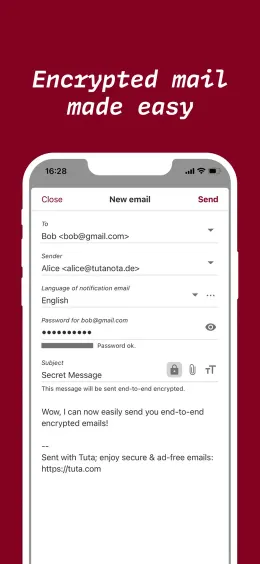
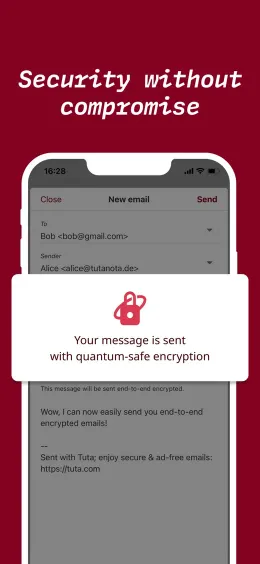
Tuta iPhone app, screen 1 of 4Tuta iPhone app, screen 2 of 4Tuta iPhone app, screen 3 of 4Tuta iPhone app, screen 4 of 4
Tuta's current iPhone app, as listed on the App Store. Screenshots are the developer's; we reproduce them to identify the product.

Score breakdown

Privacy & trust
68
Price & renewal
92
Features
92
Streaming
0
Censorship bypass
0
App quality
67
Speed (our tests)
0
Support & refunds
52
Score by dimension Tuta: Privacy 68, Price 92, Features 92, Streaming 0, Censorship 0, Apps 67, Speed 0, Support 52. PrivacyPriceFeaturesStreamingCensorshipAppsSpeedSupport
All eight dimensions scored from checkable data or our own tests.

Weights: default profile. How the score works.

Pros

  • Encrypts subject lines and the whole mailbox, not just message bodies
  • Fully open source, clients and server
  • Post-quantum encryption shipping ahead of the field
  • Encrypted calendar included on the free tier
  • Cheaper than Proton at every tier

Cons

  • No IMAP or SMTP at all, by design — you must use its apps
  • Germany is inside the Fourteen Eyes
  • A 2020 court order compelled monitoring of one account
  • Does not support PGP, so encrypted mail to outsiders uses a password link

Pricing, including what it costs after renewal

PlanIntro totalPer monthRenewal totalTrue cost / mo over 3 years
Revolutionary · 12 months$39.00$3.25$39.00$3.25
Legend · 12 months$96.00$8.00$96.00$8.00
Intro, per monthRenewal, per month
Renewal price matches the intro price on every confirmed plan. Prices in USD.

Free tier gives 1 GB with one address. Cheapest paid tier is around €3 a month and the price does not rise at renewal.

iOS app quality

App Store review analysis

100 most recent reviews across 2 storefronts, 2024-09-16 to 2026-09-01. Listing rating 4.72★ from 3,570 ratings. Version 357.260824.1, released 2026-08-27.

67
Billing complaints 8%Critical complaints 31%
iOS integration
14%
Interface & usability
12%
Privacy concerns
11%
Crashes & bugs
9%
Billing & auto-renew
8%
Customer support
7%
Connection drops
4%
Praised: reliability
4%
  • ★★☆☆☆ “I opened the app this morning, and it tells me there’s an update.” App Store reviewer, 2026-09-01
  • ★☆☆☆☆ “Really liked it for a while, but it inexplicably stopped showing new emails.” App Store reviewer, 2026-05-14
  • ★☆☆☆☆ “App won’t open on iPhone X after the last update: iOS 16.7.15.” App Store reviewer, 2026-05-05
  • ★★★★★ “I started using TUTA a few months ago.” App Store reviewer, 2026-07-30
  • ★★★★☆ “Anyway not the real reason I got tuta.” App Store reviewer, 2026-07-25

Themes tagged by keyword rules; percentages are share of sampled reviews mentioning the theme. Method.

What it does, feature by feature

Feature Tuta
Platforms iOS, Android, Mac, Windows, Linux, Browser
End-to-end encryption
Zero-access storage
Open-source clients
Custom domain
Email aliases
IMAP / SMTP
Anonymous signup
Cash or crypto accepted
Usable free tier
Encrypted calendar

A question mark means we have not confirmed the feature, not that it is missing. Hover a feature name for what it means.

What it actually does differently

Every provider in this category says it encrypts your email. Tuta encrypts more of it.

Message bodies are the easy part and everyone does them. Tuta also encrypts subject lines, the address book and the calendar, so what sits on its servers is a mailbox rather than a set of encrypted payloads wrapped in readable envelopes. Subject lines matter more than people expect: a list of them is often a serviceable summary of your correspondence, your medical appointments, your legal matters and who you bank with, with no message bodies required.

It is also fully open source on both client and server, which is a stronger position than the open-source clients most of this category offers, and it has shipped post-quantum encryption ahead of the field. Audits are on file from Cure53 in 2022 and an independent third party in 2024, both covering the apps.

That is the case for Tuta, and it is a serious one. Now the costs.

The interoperability problem

Tuta does not use OpenPGP. It uses its own encryption scheme.

This is the decision the whole product follows from. Standards-based mail encryption inherits the constraints of a format designed in the 1980s, which is why subject lines are outside the encrypted payload almost everywhere else. Building its own let Tuta encrypt the parts PGP leaves exposed and move to post-quantum primitives on its own schedule.

What it costs is interoperability, in two directions.

First, you cannot exchange encrypted mail with a PGP user the way PGP users expect. Mail leaving Tuta for a non-Tuta address either goes as ordinary unencrypted email, or as a password-protected link where the recipient reads the message on Tuta’s infrastructure using a secret you passed to them by some other channel. That mechanism is genuinely useful and it is not encrypted email, because nothing encrypted ever reaches their mailbox.

Second, and more disruptively for daily use, there is no IMAP and no SMTP at all. A conventional mail client has nothing it can read, so Thunderbird, Apple Mail and Outlook are out. Proton Mail addresses the same underlying tension with a Bridge app on paid plans, which is a compromise. Tuta declines the compromise.

If you live in a mail client, this alone should decide your shortlist, and our encrypted email ranking puts Mailbox.org and Posteo ahead for exactly that reader.

Ownership and the German problem

Tutao GmbH is founder-owned and has been operating since 2011, originally as Tutanota. Founder ownership is worth something concrete here: there are no investors requiring an exit, which is the mechanism that has consolidated most of the privacy market into the holding groups documented on our ownership explorer.

Germany is the complication. It is a Fourteen Eyes member, and unlike most jurisdictional concerns on this site, this one has already been tested. In 2020 a German court ordered Tutao to provide access to future emails in one account. The company complied, because it had to, and criticised the order publicly.

We take the same view of this as of Proton’s 2021 Swiss case. A tested provider tells you more than an untested one, and what both cases show is the same thing: jurisdiction determines whether you get an order, and encryption architecture determines what the order can actually extract. Tuta’s answer since has been to encrypt more, which is the only answer that works.

What it costs

PlanIntroRenewalTrue cost per month over 3 years
Free$0$0$0
Revolutionary, 1 year$39.00$39.00about $3.25
Legend, 1 year$96.00$96.00about $8.00

The pricing is the quietly excellent part of this product. Nothing rises at renewal, which almost nothing else in this catalogue can say, and Revolutionary at $39 a year undercuts Proton’s Mail Plus both at introduction and, by a much wider margin, at renewal. A 30-day money-back guarantee applies. Cryptocurrency is accepted; cash is not, which is one place Proton Mail goes further.

The free tier gives 1 GB with one address and includes the encrypted calendar, which is more than most free encrypted mail tiers offer.

Features

Custom domains, aliases, encrypted calendar and contacts, anonymous signup, apps on iOS, Android, macOS, Windows, Linux and the browser. Zero-access storage, so what Tuta holds it cannot read.

The omissions are the ones already covered: no IMAP, no SMTP, no PGP. There is no ecosystem of adjacent products the way Proton has one, so if you want an encrypted drive, a password manager and a VPN on the same account, this is not that.

The iPhone app

Our App Store analysis used a sample of 100 recent reviews from the United States and Great Britain storefronts, against a listing rating of 4.72 stars from about 3,570 ratings.

The sample mean was 3.53 and sentiment was mildly positive and improving. The most common theme was iOS integration at 14 per cent, followed by interface and usability at 12 per cent, privacy concerns at 11 per cent, crashes at 9 per cent and billing or auto-renew at 8 per cent. The iOS integration figure is the one that fits the product: an app that cannot fall back on the system mail client carries the whole burden of the experience itself, and complaints about how it sits inside iOS are what you would predict from the architecture. A sample of 100 is small, so read the ranking of themes rather than the percentages.

Where it lands

The most thoroughly encrypted mailbox available, at the lowest sustained price in the category, from a founder-owned company that responded to being compelled by encrypting more. If those are your priorities, nothing else here competes.

The compatibility cost is not a detail you will get used to. No IMAP means no existing client, and no PGP means the encryption effectively stops at Tuta’s boundary for anyone you write to outside it. Decide on those two before you decide on anything else.

What we have not tested

We have not run our own hands-on testing of Tuta’s apps, its post-quantum implementation, or the password-protected message flow to external recipients. Our provider record flags ownership, jurisdiction and audit history as still needing a primary-source check, and neither audit entry carries a published report URL on file. The App Store figures are drawn from Apple’s public review feed, not from testing we performed.

Tuta against the top two encrypted email

Feature TutaProton MailMailbox.org
Platforms iOS, Android, Mac, Windows, Linux, BrowseriOS, Android, Mac, Windows, Linux, BrowserBrowser
End-to-end encryption
Zero-access storage
Open-source clients
Custom domain
Email aliases
IMAP / SMTP
Anonymous signup
Cash or crypto accepted
Usable free tier
Encrypted calendar

A question mark means we have not confirmed the feature, not that it is missing. Hover a feature name for what it means.

Sources

2 sources · verification needs primary source check

Assembled from public sources; confirm ownership, jurisdiction and audit history against primary documents.

Frequently asked questions

What does Tuta encrypt that Proton does not?

Subject lines, and the mailbox as a whole rather than message bodies alone. In most encrypted mail systems the subject travels and is stored in the clear, because the standards that encrypted mail was built on left it outside the encrypted payload. Tuta encrypts it, along with the address book and calendar. Subject lines routinely give away more than people realise, so this is a real difference rather than a specification-sheet one.

Why does Tuta not support PGP?

It uses its own encryption scheme rather than OpenPGP, which is a deliberate architectural choice that buys the subject-line encryption and the post-quantum work but breaks interoperability. The practical result is that you cannot exchange encrypted mail with a PGP user in the ordinary way. Mail to anyone outside Tuta either goes unencrypted like any normal email, or as a password-protected link the recipient opens on Tuta's side using a secret you shared separately.

Is there really no IMAP?

None at all, and this is by design rather than a missing feature. Because everything is encrypted client-side under Tuta's own scheme, a standard mail client has nothing it can read, so Thunderbird, Apple Mail and Outlook simply cannot be used. Proton solves the same problem with its Bridge app on paid plans. Tuta does not solve it, it removes the requirement, and you must use Tuta's own apps for everything.

Who owns Tuta and where is it based?

Tutao GmbH, a founder-owned German company formerly known as Tutanota, operating since 2011. Founder ownership means no investor exit pressure, which is the structural risk that has reshaped much of this market. Germany is the complication: it is a Fourteen Eyes member, and a German court has already compelled the company once.

What happened in the 2020 German case?

A German court ordered Tutao to provide access to future emails in one account. The company complied, as it was legally required to, and publicly criticised the order. Its response since has been architectural rather than rhetorical: encrypt more, so that less exists to be handed over. That is the correct response, and it is worth reading alongside Proton's 2021 Swiss case, because both show that jurisdiction alone protects nobody and only the encryption design determines what a compelled provider can actually produce.

How much does Tuta cost?

The free tier gives 1 GB with one address and includes an encrypted calendar, which is unusually generous. Revolutionary is $39 a year and Legend is $96 a year, and neither rises at renewal, which is rare in this market. A 30-day money-back guarantee applies and cryptocurrency is accepted, though cash is not.