
The ownership case, which is the whole case
Every product in this category encrypts your vault on your device and stores a blob it says it cannot read. Because the technical claims converge, the question that actually separates them is what the company is for over the ten or twenty years you will keep the vault.
Proton Pass has the best answer available. Proton AG is Swiss, and since 2024 its controlling shareholder has been the Proton Foundation, a Swiss non-profit. There is no private-equity owner waiting to extract value, as there is behind LastPass, and no large venture round implying an eventual exit, as there is behind 1Password and, more mildly, Bitwarden. Switzerland is outside the Five, Nine and Fourteen Eyes arrangements.
That is not a claim that the product is better. It is a claim about who will be holding your data in 2036, and it is the only claim in this category that a foundation structure can make.
Jurisdiction, without overselling it
Switzerland is a genuinely better legal home than the United States or Canada for a company that holds user data, and we say so. It is not a magic shield. Swiss courts can compel a Swiss company, and Proton has published transparency reports showing it complies with valid Swiss legal orders when they arrive, which is what a lawful company does.
What matters is what there is to compel. For a password manager, the answer is an encrypted vault plus account metadata, and the vault is protected by your master password and the key derivation behind it. Jurisdiction shapes the metadata risk and the legal process; it does not change the cryptography.
Open source and audits
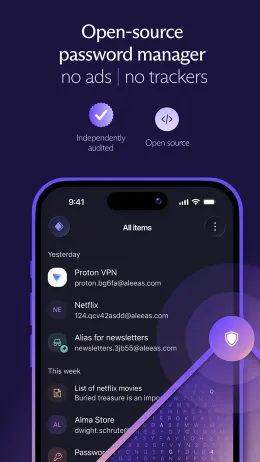
The clients are published and Cure53 audited the product in 2023 and 2024, with the results made public. Two audits is fewer than Bitwarden’s run of three consecutive years and fewer than 1Password’s, and that is a straightforward consequence of the product being two years old when the second one landed rather than a sign of neglect.
The combination that matters is present: code anyone can read, and an external team that has looked at it. That is the standard we apply on our best password managers page, and only Bitwarden and Proton Pass meet it in full.
Email aliases, the feature that is actually different
Proton owns SimpleLogin, and Pass uses it. That means generating a unique forwarding address per service is a first-class action in the manager rather than an add-on you have to remember to wire up.
The practical value is containment. When a retailer is breached, or quietly sells its mailing list, the damage is limited to one address you can switch off, and you learn which company leaked because only that alias starts receiving spam. Ten aliases come with the free tier, which is enough to protect the accounts most likely to be sold on. Unlimited aliases are the clearest reason to pay.
No other major manager has this properly integrated, and it is the one place where Proton Pass is not catching up to the field but ahead of it.
What it costs
| Plan | Intro | Renewal | True cost per month over 3 years |
|---|---|---|---|
| Free | $0 | $0 | $0 |
| Pass Plus (1 year) | $47.88 | $71.88 | about $5.32 |
| Pass Plus (2 years) | $71.76 | $143.76 | about $3.99 |
This is the only one of the four managers we cover where the renewal price is above the intro price, and it is the pattern this site spends most of its time criticising in the VPN market. On the annual plan you pay $47.88 once and $71.88 every year after, which over 36 months is about $5.32 a month. The two-year plan is the better buy at about $3.99 a month over the same window, because the discounted first term covers more of it. Our true cost calculator does this arithmetic for whichever term you are looking at.
Both figures are above Bitwarden Premium and, on the annual plan, above 1Password Individual. There is a 30-day money-back window, and cryptocurrency is accepted.
The bundle changes the picture completely. If you already pay for Proton VPN or Proton Mail on a plan that includes Pass, the marginal cost of the password manager is nothing, and at that point the comparison is not close.
Features and gaps
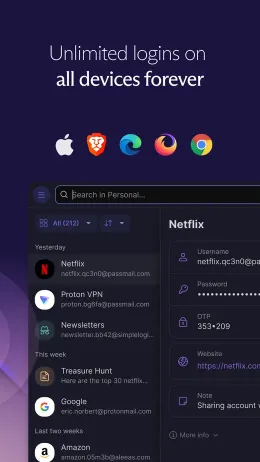
Passkeys, end-to-end encryption, an offline vault, breach monitoring, secure sharing, emergency access, family plans, browser extensions, and apps across iOS, Android, macOS, Windows, Linux and the browser. Pass Plus adds a built-in two-factor authenticator.
The gaps are real. It is not self-hostable, so unlike Bitwarden you cannot take the operator out of the picture. Enterprise administration is thinner than 1Password’s or Keeper’s, and if you are provisioning a hundred staff that difference will show up quickly. And the product simply has fewer years of accumulated edge-case handling behind it than managers that have been fixing import bugs since 2008.
Who it is for
Someone for whom the question is not which app is nicest but who will own the company. Someone who wants aliasing without running a second service. And anyone already inside the Proton subscription, for whom this is the obvious default and effectively free.
If you need self-hosting, Bitwarden is the answer. If you need the most polished apps for a non-technical household, 1Password is. If you want a master password worth putting in front of any of them, the password generator here runs locally.
What we have not tested
We have not run our own hands-on testing of Proton Pass. Import fidelity, autofill behaviour across browsers, alias management at scale and device recovery are all untested by us, and no figure on this page comes from a measurement we made. The relevant dimensions of the score stay pending until we do that work and publish it.